
Outsourced Bookkeeping for UK Businesses: What You Get
Outsourced bookkeeping explained for UK limited companies, sole traders and startups: what is handed over, how it works, what stays with you and how to choose.
Outsourced Bookkeeping for UK Businesses: What You Get
Outsourced bookkeeping means an external accountancy team keeps your day-to-day financial records for you: sales, expenses, bank entries, VAT and payroll data. You stop chasing receipts and reconciling statements at the weekend, and your numbers are ready when HMRC or Companies House needs them. At TurnerBerry, each client works with a named accountant, on a fixed monthly fee, using cloud accounting software and our own client portal. That is the model this guide explains, so you can judge it against your own business.
Key Takeaways
- Outsourcing hands over the routine record-keeping. You stay legally responsible for the records, the filing dates and the tax bill, so the best arrangement is one where someone is accountable for each of them.
- Bookkeeping that sits with your accountant means the records, VAT, payroll and year-end accounts all draw on the same data, with fewer queries and fewer re-keyed figures.
- Fixed monthly fees make the cost predictable. Fees depend on the services you need and how complex your business is.
- Limited companies, sole traders and startups all need records that meet HMRC’s digital rules, and that is a reason to set things up properly from day one.
- Moving from a previous accountant is manageable when the new firm handles the transfer for you.
Table of Contents
- What outsourced bookkeeping actually covers
- Why the records matter more than they used to
- What your business type needs
- How it works day to day
- Outsourced bookkeeping compared with doing it yourself or hiring in-house
- What it costs
- How to choose an outsourced bookkeeping service
- When outsourcing makes the most sense
- Moving from your current accountant
- Where TurnerBerry fits
- FAQ
- Sources
What outsourced bookkeeping actually covers
GOV.UK describes bookkeeping as the way you know what you have, what you owe and what you are owed. The same page lists the records a business must keep: sales, income, expenses, bank, debt and PAYE records. Outsourcing means a professional team does that work on your behalf, on a regular schedule, instead of you doing it in the evenings.
In practice, the work usually breaks down like this:
- Recording and categorising transactions. Sales invoices, supplier bills and expenses are entered and coded.
- Bank reconciliation. Your bank statements are matched against your books so nothing is missing or duplicated.
- VAT. Figures are prepared for your VAT returns from the same records.
- Payroll data. Pay, PAYE and pension figures feed into payroll and pensions.
- Reporting. You see where the business stands, rather than waiting for the year end.
If you are unsure where bookkeeping ends and accounting begins, our guide to bookkeeping versus accounting sets out the difference. In short, bookkeeping records what happened. Accounting turns those records into accounts, tax returns and advice.
Why the records matter more than they used to
Bookkeeping is not just admin. GOV.UK says good records make it easier to plan, budget, pay the right amount of tax and show lenders or investors that the business is healthy. When the books are late or patchy, the usual result is a rushed year end, guesswork on expenses and tax paid on income that could have been reduced.
There are legal reasons too. GOV.UK says a limited company must keep records of all money received and spent, assets, debts, year-end stock and goods bought and sold. It also says you can face a £3,000 fine from HMRC or director disqualification for failing to keep accounting records. Those records must be kept for 6 years from the end of the last company financial year they relate to.
What your business type needs
The records you need depend on how you trade.
Limited companies
Every company must file annual accounts with Companies House. Private companies generally have 9 months after the accounting reference period to do so. The same guidance says that from 1 April 2028, accounts must be filed using commercial software in iXBRL format, a structured digital format. Accounts built on tidy, regularly updated books are far easier to prepare in that format. Our limited company accounts service sits on top of the bookkeeping, so the same team prepares both. Directors weighing up doing it themselves can read whether you can do your own limited company accounts.
Sole traders
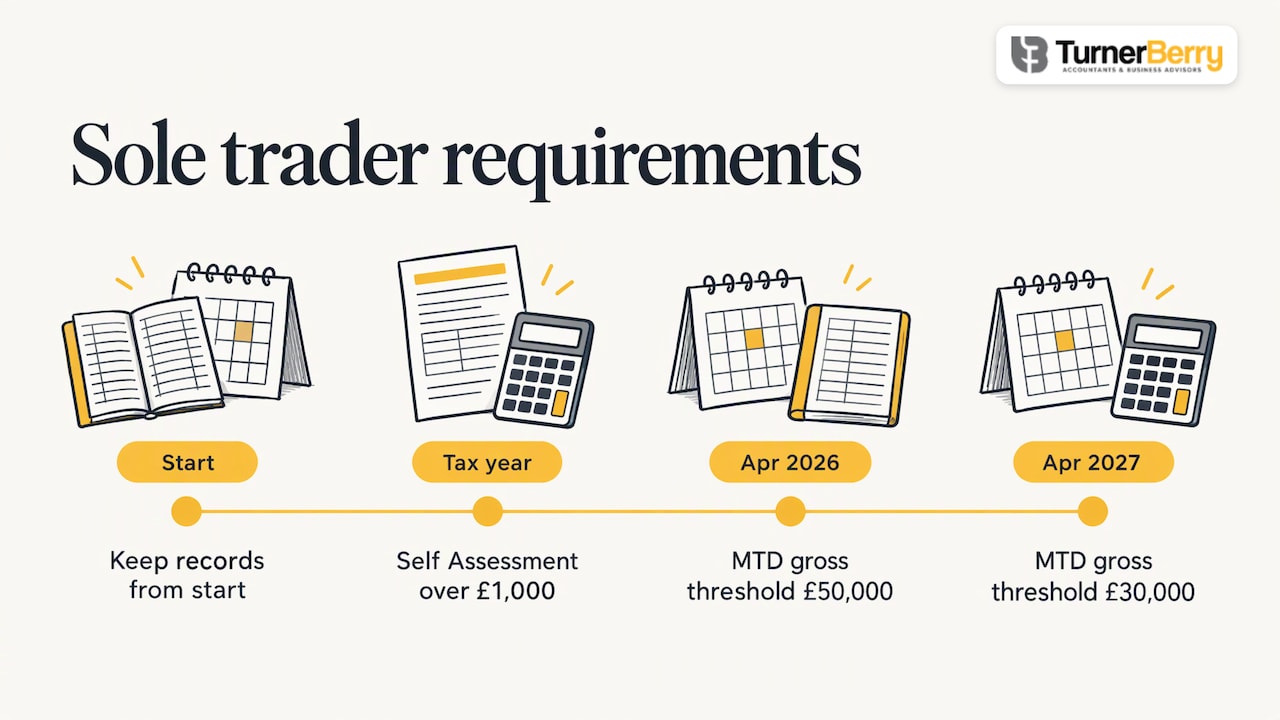
GOV.UK says sole traders must keep records from the day they start trading and register for Self Assessment if they earn over £1,000 in a tax year. Making Tax Digital (MTD) for Income Tax is the bigger change. The 2024 regulations moved its start to April 2026 and set the qualifying income threshold at £50,000 from April 2026 and £30,000 from April 2027.
The test is on gross income, not profit, and it combines self-employment and property income. ICAEW’s Tax Faculty explains that someone over £50,000 in 2024/25 who drops below it in 2025/26 still has to comply from April 2026. If you are near a threshold, your records need to be digital and up to date, not pieced together in January. Our sole trader accountants in Bristol page explains how we support this group, including Self Assessment.
Startups
A new business has the least time and the most to set up: registering, choosing software, deciding on VAT and payroll. Getting a bookkeeping routine in place in the first month avoids a clean-up job at the end of the first year. If you are a new director, remember that Companies House identity verification applies to you too, and we offer Companies House ID verification at £48 one-off per person.
How it works day to day
A good outsourcing arrangement follows a simple pattern.
- Onboarding. You share your business details and access to your bank feeds, invoices and receipts. Ours is online, so there is no need to post paperwork or sit through an office visit.
- Software and portal. Your records live in cloud accounting software, and our proprietary client portal gives you one place to upload documents and see your information.
- Regular bookkeeping. Transactions are recorded and reconciled on an agreed schedule: weekly, monthly or quarterly, depending on the volume of your activity.
- Returns and accounts. VAT, payroll, corporation tax and year-end accounts are produced from the same set of books.
- Review. Your named accountant looks at the figures with you and points out what to act on.
The software point is not a detail. For VAT, HMRC’s VAT Notice 700/22 says a third party such as a bookkeeper needs either full access to your digital business records or electronic extraction of data. It also says MTD VAT records must be kept in functionally compatible software with digital links between the programs used. Paper handed over in a carrier bag no longer fits that model. Our cloud accounting services page shows what that looks like in practice.
What you keep responsibility for
Outsourcing does not move the legal duty. ICAEW’s draft engagement letter schedule for MTD income tax shows the usual split: the firm can keep digital records, prepare them weekly, monthly or quarterly and submit quarterly updates. The client remains legally responsible for compliant records, filing by the due dates and paying tax on time, and approval of the return cannot be delegated.
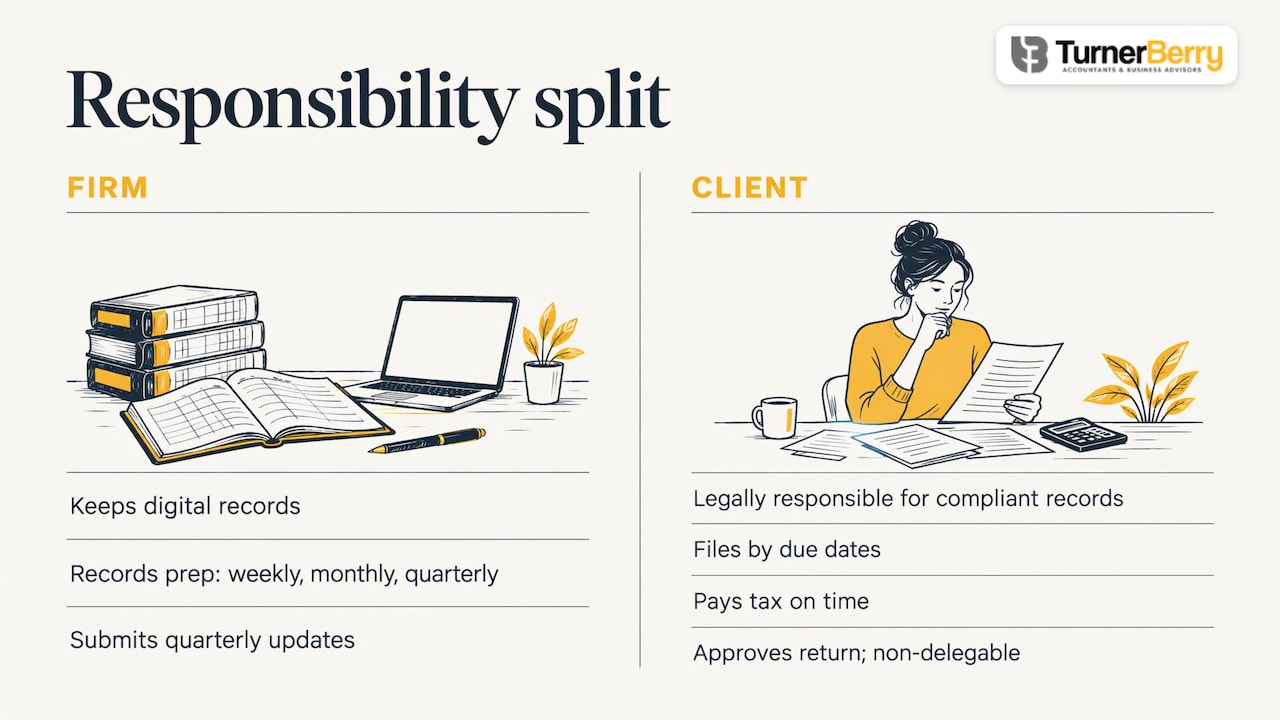
In practice, that means you approve what is filed and you get your information to your accountant on time. A named accountant who knows your business makes that approval quick and informed, rather than a signature on a document you have not seen before.
Outsourced bookkeeping compared with doing it yourself or hiring in-house
| Doing it yourself | Employing a bookkeeper | Outsourced with TurnerBerry | |
|---|---|---|---|
| Your time | Evenings and weekends | Little | Little: you upload and approve |
| Cost pattern | Software and your own hours | Salary and employment costs | Fixed monthly fee based on services and complexity |
| Link to tax and accounts | You pass figures on | Often a separate step | Same team prepares returns and accounts |
| Cover for holidays | None | Gaps when they are off | A named accountant within a firm |
| Digital record rules | You keep up with changes | Their knowledge only | Handled in cloud software and our portal |
The real difference is not the hours saved. It is that bookkeeping, VAT, payroll and year-end accounts are all prepared from one record by people who know your business. When these jobs are split between you, a part-time helper and an accountant, mistakes tend to appear at the joins: a missing invoice, a VAT figure that does not match the ledger, a payroll number entered twice.
What it costs
GOV.UK gives no fee figures for bookkeeping, and says accountancy may involve one-off fees or a monthly retainer. It also notes that some banks offer a free subscription to MTD-compliant accounting software.
At TurnerBerry, fees are a fixed monthly amount based on the services and the complexity involved. Three things move the price most:
- Volume of transactions. More invoices, bills and bank lines means more to record and reconcile.
- Scope. Bookkeeping alone costs less than bookkeeping with VAT, payroll, CIS returns and accounts.
- Complexity. Multiple income streams, stock, foreign currency or a messy back catalogue add work.
A fixed fee is easier to budget than hourly billing because you know the monthly figure before the work is done. We scope it with you first, so the quote reflects what you actually need. You can see what is involved on our bookkeeping services in Bristol page.
How to choose an outsourced bookkeeping service
Whether you are in Bristol, Cardiff, Bath or Weston-super-Mare, the same questions apply.
- Who will you deal with? Look for a named person, not a ticket queue. Each of our clients has a named accountant.
- What is included in the fee? Ask whether VAT, payroll, CIS and year-end accounts sit inside the same arrangement or are billed separately.
- Which software is used? It should be cloud-based and compatible with HMRC’s digital requirements. Records you can see at any time are better than records you wait to be sent.
- How is your data handled? You are sharing bank and customer information, so ask where it is stored and who can see it. A client portal is better than email attachments.
- How does onboarding work? A clear online process, with the transfer from your previous accountant managed for you, takes much of the strain out of switching.
- Is the advice proactive? Bookkeeping is the foundation. The value comes when someone reads the numbers and tells you about tax-saving options before the year end.
- Is the fee fixed? Predictable monthly pricing lets you plan cash flow around it.
If you are choosing in Weston-super-Mare, our guide to choosing a business accountant there goes through the same checks locally.
When outsourcing makes the most sense
The signs are usually obvious in hindsight:
- You are behind on reconciling the bank and dread opening the software.
- You have crossed, or are about to cross, the VAT registration limit and need to keep digital VAT records. Our VAT registration help explains the process.
- You have taken on your first employee and need payroll and pension records.
- You work under the Construction Industry Scheme and need monthly CIS returns.
- You are a director paying yourself in the most tax-efficient way and want the books to support that. Our guide on limited company allowable expenses shows why clean records matter.
- You are growing and need forecasts or planning, not just a record of the past.
In each case, the benefit is the same: your figures are up to date, so decisions on pricing, hiring and tax are based on what has actually happened this month.
Moving from your current accountant
Many owners stay with an arrangement that no longer suits them because switching sounds painful. It rarely needs to be. We manage the transfer from your previous accountant, and onboarding is online. You tell us who you are leaving, and we handle the handover of the information we need, so you are not left chasing records yourself.
Where TurnerBerry fits
TurnerBerry has more than 20 years of experience and over 500 clients, including limited companies, sole traders, startups and growing businesses in Bristol and Cardiff. Bookkeeping is part of a wider service that also covers corporation tax, Self Assessment, VAT, payroll and pensions and CIS returns, all delivered with cloud accounting software and our proprietary client portal.
If you want your records kept up to date by a named accountant, on a fixed monthly fee, with the transfer from your previous accountant handled for you, start with our bookkeeping service.
Tell us what you do, how many transactions you handle and which of VAT, payroll and accounts you need, and we will scope the monthly fee with you. You can also see how we work with limited company accountants in Bristol.
This guide is general information, not advice tailored to your circumstances.
FAQ
Is outsourced bookkeeping worth it for a small business?
It is worth it when the time you spend on records, or the cost of mistakes, outweighs the monthly fee. Owners who outsource get up-to-date figures, VAT and payroll prepared from the same books, and more time to run the business. A fixed monthly fee also makes the cost easy to plan.
What is the difference between bookkeeping and accounting?
Bookkeeping records your day-to-day transactions: sales, expenses and bank entries. Accounting uses those records to prepare accounts and tax returns and to advise you. Having both with one firm means the figures only need to be entered once.
Do I still have legal responsibility if I outsource?
Yes. The business remains responsible for keeping compliant records, filing by the due dates and paying tax on time, and the approval of a return cannot be delegated. Your accountant prepares the work and you sign it off.
Can I outsource bookkeeping as a sole trader?
Yes. Sole traders can have their records kept digitally and, where MTD for Income Tax applies, have quarterly updates prepared for them. Whether you are in scope depends on your gross income, so it is worth checking your position before the threshold applies to you.
How much does outsourced bookkeeping cost?
There is no standard national price. The fee depends on the volume of transactions, the services included and the complexity of the business. We quote a fixed monthly fee once we know what you need.
Sources
- Setting up business accounting and finance, Business.gov.uk
- Running a limited company: company and accounting records, GOV.UK
- Preparing and filing Companies House accounts, GOV.UK
- Set up a business, GOV.UK
- The Income Tax (Digital Requirements) (Amendment) Regulations 2024, legislation.gov.uk
- TAXguide 04/25: Making Tax Digital for income tax, ICAEW
- VAT Notice 700/22: Making Tax Digital for VAT, GOV.UK
- Draft MTD income tax engagement letter schedule, ICAEW
Recommended
This guide is general information based on the rules when it was published on 26 November 2026. It isn't advice for your situation, so talk to us before acting on it.
NEED A HAND?
Books that are always up to date.
Cloud bookkeeping, reconciled every week, so you always know where you stand.