
Cloud Accounting Services for UK Businesses: What You Get
What cloud accounting services include, how they work with Making Tax Digital, what to check before you sign, and how a named accountant fits in.
Cloud Accounting Services for UK Businesses: What You Get
Cloud accounting services combine online accounting software with an accountant who works in your books as you trade. Your records stay up to date, your tax filings come from the same data, and someone qualified spots problems before a deadline does. At TurnerBerry, each client works with a named accountant, supported by cloud accounting and our own client platform, for a fixed monthly fee.
This guide explains what the service covers, how it works with Making Tax Digital (MTD), what records you must keep and what to check before you choose. It is general information, not advice for your circumstances.
- ✓Self-assessment
- ✓Payroll
- ✓VAT returns
Key Takeaways
- Software tidies your bookkeeping. An accountant uses those books to help with tax efficiency, forecasts, financial statements, deadlines and compliance.
- Tax and finances stay your responsibility, even with an accountant, so you need a service that keeps you informed and in control.
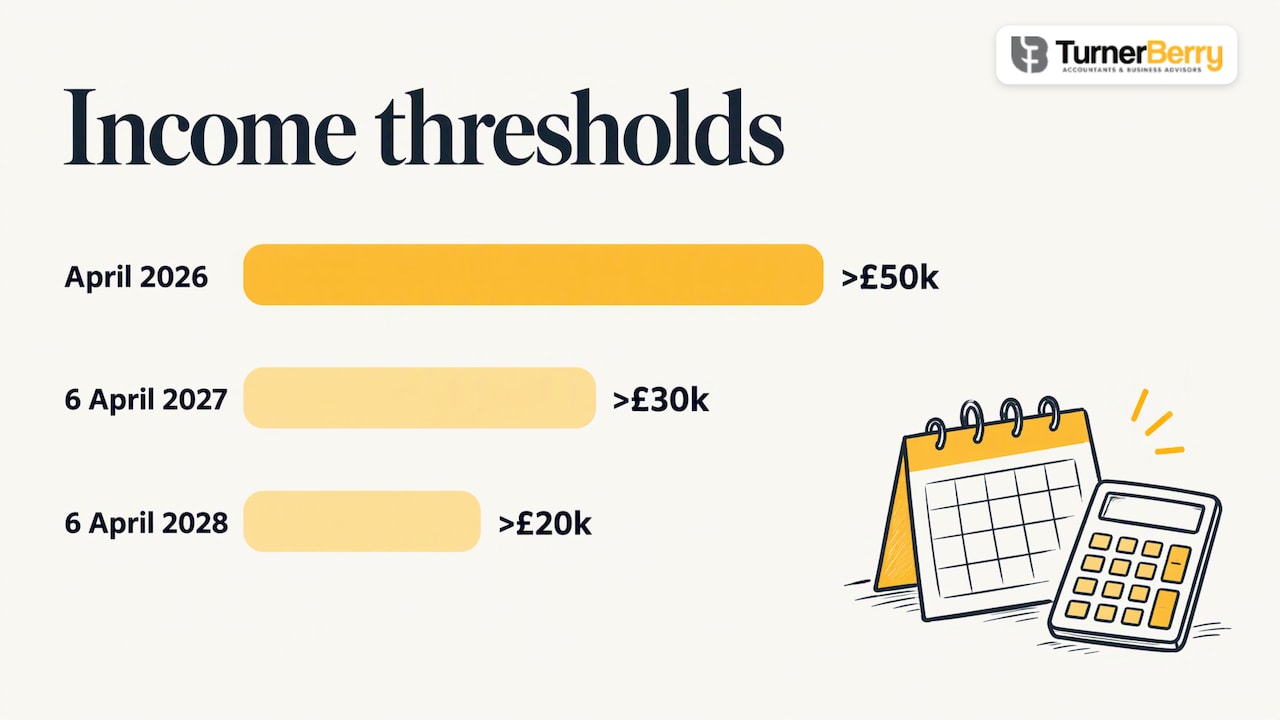
- MTD for Income Tax applies to sole traders and landlords with qualifying income above £50,000 from April 2026, above £30,000 from April 2027 and above £20,000 from April 2028.
- VAT-registered businesses already need compatible software and digitally linked records.
- Accountancy is commonly charged as a one-off fee or a monthly retainer, so compare what the monthly fee covers, not just the headline figure.
Table of Contents
- What cloud accounting services actually include
- How the process works, from receipt to filing
- Making Tax Digital: what applies to you
- Records you need to keep
- What to check before choosing a cloud accounting service
- Which businesses benefit most
- Cloud accounting with TurnerBerry
- FAQ
- Sources
What cloud accounting services actually include
There are two parts, and people often confuse them.
The first is software: an online system where bank transactions, invoices and receipts are recorded. Official guidance from Business.gov.uk says accounting software can reduce duplicated work and make tax returns easier.
The second is the accountant. The same guidance explains that an accountant can use your books to assess performance and help with tax efficiency, forecasts, financial statements, deadlines and compliance. Software alone does none of that. It stores and sorts data, but someone still has to decide how a transaction should be treated, whether a cost is allowable and what it means for your tax bill.
In practice, a full cloud accounting service for a small business usually covers:
- Bookkeeping, kept current in the cloud rather than reconstructed at year end. See our bookkeeping service.
- Year-end accounts for limited companies, filed at Companies House. See limited company accounts.
- Tax returns: corporation tax for companies and Self Assessment for sole traders, directors and landlords.
- VAT returns, prepared and submitted through compatible software.
- Payroll and pensions if you employ staff or pay yourself through PAYE (Pay As You Earn, the system for deducting tax from wages).
- CIS returns for contractors and subcontractors in the Construction Industry Scheme.
- Planning: forecasts, tax planning and startup support.
That is the range we offer at TurnerBerry, delivered with cloud accounting software and our own client portal.
How the process works, from receipt to filing
The workflow is the same whatever the business type.
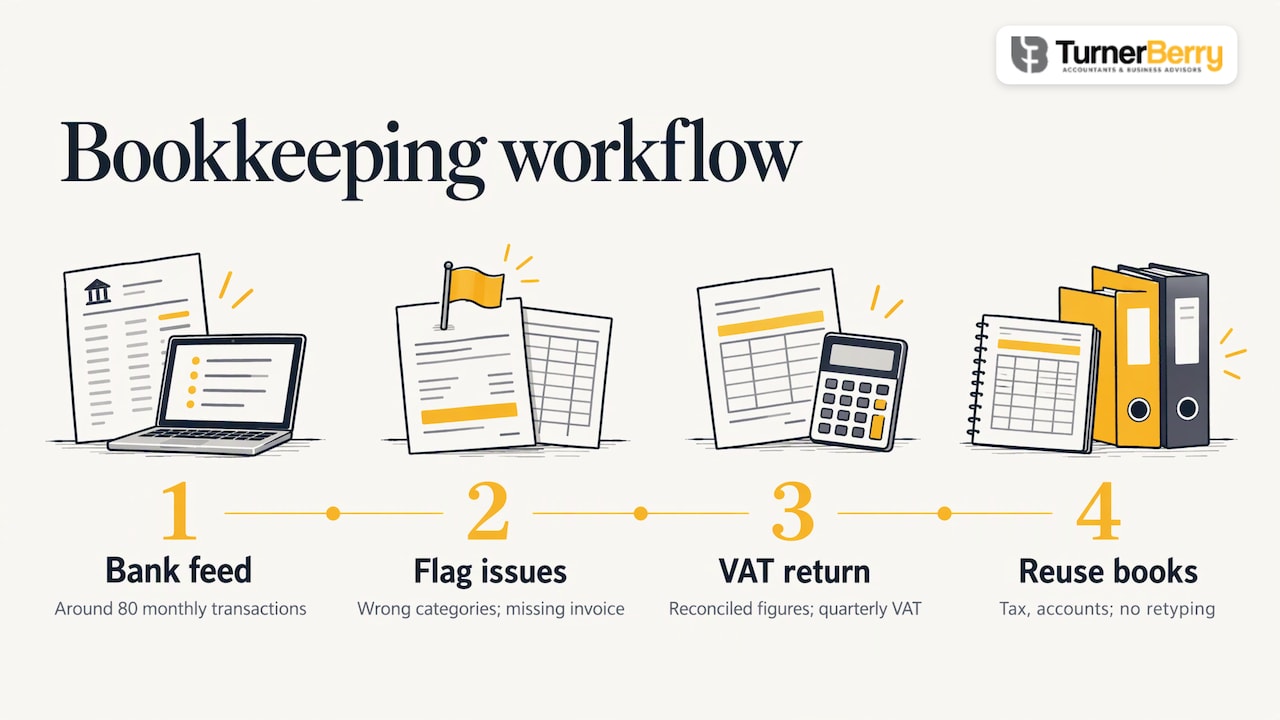
- Transactions are captured. Bank feeds bring in payments automatically. Invoices and receipts are uploaded or photographed.
- Records are checked. HMRC’s guidance on digital records says bank feeds may omit details needed for the record, and that the taxpayer is responsible for checking accuracy before sending quarterly updates. This is where an accountant earns their fee: categories, VAT treatment and missing paperwork are caught here.
- Reports are produced. Profit and loss, balance sheet and VAT figures come straight from the books.
- You approve, then it is filed. For VAT, HMRC’s notice says the software displays the compiled return for the business to confirm as correct and authorise, and then confirms receipt. A guide from the Institute of Certified Bookkeepers describes the same pattern: reports presented to the client, signed electronically and filed with HMRC after approval.
The approval step matters. You are not handing over responsibility. You are getting figures that are ready to approve, prepared by someone who has checked them.
A worked example
Take a Bristol limited company with a director and two employees. Each month the bank feed brings in around 80 transactions. Without regular attention, a handful end up in the wrong category, and a supplier invoice is missing. In a cloud setup those items are flagged when they happen, so the quarterly VAT return is built from reconciled figures rather than a last-minute scramble. The same books then feed the corporation tax return and the year-end accounts, so nothing is typed in twice.
Making Tax Digital: what applies to you
MTD is the reason cloud software has moved from optional to expected. Here is who is affected.
| Who | Rule | Starts |
|---|---|---|
| VAT-registered businesses | Digital records and submission through compatible software, unless exempt | Already in force |
| Sole traders and landlords, qualifying income above £50,000 | MTD for Income Tax | April 2026 |
| Qualifying income above £30,000 | MTD for Income Tax | 6 April 2027 |
| Qualifying income above £20,000 | MTD for Income Tax | 6 April 2028 |
The phased thresholds are set out in The Income Tax (Digital Obligations) Regulations 2026. HMRC confirms that turnover for the threshold means gross self-employment and property income before allowances or expenses. So a sole trader with £32,000 of sales and £15,000 of costs is counted at £32,000.
If you are in scope, you use compatible software to keep digital records, send quarterly updates and complete the annual return. Quarterly updates are summaries, not tax returns, and you still pay your full Income Tax bill by 31 January after the tax year.
Limited companies are not covered by MTD for Income Tax, but company directors with sizeable property or self-employed income outside the company can be. If that is you, check the figures against the thresholds above. Our sole trader accountants and landlord accountants pages explain how we support each group.
Records you need to keep
Cloud software does not remove the duty to keep records. It makes keeping them easier.
For MTD for Income Tax, HMRC says records should include the amount, date and category of each transaction. Supporting documents such as bank statements and invoices must still be kept. Digital records should be kept for at least five years after the 31 January submission deadline for the relevant year.
For VAT, HMRC says records must generally be kept for at least six years. If you use more than one software product, the records must be digitally linked. Copying and pasting between products does not meet the rule. ICAEW’s guidance adds that spreadsheets can hold records but need compatible software to communicate with HMRC, and that manual rekeying is not allowed once the first record is entered.
Business.gov.uk lists the basics worth keeping: sales and other income, business expenses, bank statements, debts owed and payable, and PAYE records if you employ staff.
A simple routine:
- Upload receipts the day you get them.
- Reconcile the bank feed at least monthly.
- Chase missing invoices before the quarter closes, not after.
- Keep supporting documents for the full retention period.
What to check before choosing a cloud accounting service
Business bodies agree on the main points. The Northern Ireland business advice service lists fit for size and sector, cost and add-ons, audit trails, MTD recognition, setup and training costs, security, backups and compatibility with your accountant’s software. Turn that into questions for any provider:
Who is my accountant? You want a named person who knows your business, not a queue. Each TurnerBerry client has a named accountant.
Is the software MTD-ready? For VAT it must be. For Income Tax, ICAEW advises checking whether a product handles the annual return and multiple income streams.
How do integrations work? The ICB guide explains that APIs let cloud programs exchange data and can reduce manual input. Ask what actually transfers between the tools you use, such as your bank, payroll and invoicing.
What support do I get? The same guide recommends looking at support quality, training and account management.
What does the fee include? Business.gov.uk notes accountancy can be charged as one-off fees or a monthly retainer. A fixed monthly fee makes budgeting simple, provided you know which services it covers. Software licences, payroll and VAT may or may not be included, so ask for the scope in writing.
What happens at the start? Moving from a previous accountant puts many owners off. We run online onboarding and manage the transfer from your previous accountant.
Our tools and technology page shows the software side of how we work.
Which businesses benefit most
Limited companies. Accounts, corporation tax, VAT, payroll and director’s Self Assessment all draw on the same data. Keeping them in one cloud system avoids duplicate entry. See our limited company accountants page.
Sole traders. Whether you are already in MTD or heading towards the £30,000 or £20,000 thresholds, digital records from the start mean no scramble when your turn comes.
Startups. Getting the structure right from day one, with bookkeeping set up, VAT registration considered and payroll ready for your first hire, saves rework later. Our guide on VAT registration is a useful starting point.
Growing businesses. As transactions multiply, forecasts and tax planning matter more. Our growing business accountants page covers the planning side.
Contractors. If you work in construction, CIS deductions need accurate monthly returns. Our contractor accountants page explains the support.
Cloud accounting with TurnerBerry
TurnerBerry has more than 20 years of experience and over 500 clients, and we build our own accounting software to improve data accuracy and simplify processes. You get cloud accounting, our client portal, a named accountant and proactive advice, with a fixed monthly fee based on the services and complexity you need. We work with businesses in Bristol and Cardiff, and across the surrounding area including Bath and Weston-super-Mare.
If you want to see how it would work for your business, get in touch with TurnerBerry and we will talk through the services you need. If you are a director who needs to verify your identity with Companies House, we also offer ID verification at £48 one-off per person.
FAQ
Is cloud accounting the same as accounting software?
No. Software is the tool that records and organises your figures. A cloud accounting service adds an accountant who works in those figures, prepares your tax filings and advises on planning. Tax and finances remain your responsibility, so you review and approve what is filed.
Do I need cloud accounting to comply with Making Tax Digital?
You need compatible software that keeps digital records and talks to HMRC. VAT-registered businesses already need this. Sole traders and landlords need it once their qualifying income passes the threshold that applies to them, starting at £50,000 from April 2026.
How much do cloud accounting services cost?
It depends on the services and the complexity of your business. Accountancy is commonly charged either as one-off fees or as a monthly retainer. Ask any provider what the fee covers, including software, VAT, payroll and year-end accounts.
How long should I keep digital records?
For MTD for Income Tax, at least five years after the 31 January submission deadline for the relevant year. For VAT, generally at least six years. Keep supporting documents such as invoices and bank statements as well.
Can I move to a new accountant without disruption?
Yes. We run online onboarding and manage the transfer from your previous accountant, so you do not have to chase files yourself.
Sources
- Setting up business accounting and finance, Business.gov.uk
- Use Making Tax Digital for Income Tax: create digital records, GOV.UK
- VAT Notice 700/22: Making Tax Digital for VAT, GOV.UK
- The Income Tax (Digital Obligations) Regulations 2026, legislation.gov.uk
- Sole traders and landlords earning more than £30,000 urged to act now, GOV.UK
- Check what to do if HMRC has signed you up for Making Tax Digital for Income Tax, GOV.UK
- Keeping VAT records, GOV.UK
- Choosing software for MTD income tax, ICAEW
- ICB Software Guide, September 2024
- Choosing the right accounting package, nibusinessinfo.co.uk
Recommended
This guide is general information based on the rules when it was published on 25 November 2026. It isn't advice for your situation, so talk to us before acting on it.
NEED A HAND?
Talk it through with us.
Every business is different. Book a free discovery call and get advice for your situation.